
Intelligent and Sustainable Engineering PhD Program
Intelligent and Sustainable Engineering PhD Program
National Ilan University, Taiwan. Five places a year, more than 60 professors, taught entirely in English. The first doctoral program in eastern Taiwan at the intersection of intelligent technology and sustainable engineering.
Last updated: September 2026
Why Choose This Program
1. Five students per year, more than 60 professors
Large research universities admit dozens of doctoral students per cohort, and supervisors are stretched thin. This program admits 5 students per year while drawing on over 60 full-time professors in the College of Engineering, including 12 named on the Stanford University / Elsevier "World's Top 2% Scientists" list, who average over 16 publications each. You get genuine supervision, not a place in a queue.
2. An institution investing seriously in AI
National Ilan University is a member of the Taiwan AI College Alliance (TAICA), established an AI Promotion Office in 2024, and became an NVIDIA partner university in 2025. For a doctoral program that treats artificial intelligence and computational thinking as core competencies for every student, this institutional commitment is not decoration; it is infrastructure.
3. Taught entirely in English, by design
Every course is delivered in English. This is not an accommodation added for international students; it is how the program was built.
4. A strong path to staying in Taiwan
Graduates may stay and work in Taiwan for up to two years after completing the degree. You are not forced to line up a sponsoring employer before your student visa expires.
5. Interdisciplinary backgrounds welcome
The program accepts applicants whose previous degrees are not in engineering, where their research interests align with the three pillars.
Six Research Themes
1. Smart Manufacturing
Advanced automation and intelligent systems development, covering smart factories, industrial sensors and sensing circuit design, digital image processing, and 3D printing applications.
2. Sustainable Green Technology
Energy conservation and carbon reduction, covering carbon net-zero planning, engineering carbon emission management and life cycle assessment, circular economy and resource reuse, renewable energy, fuel cells, advanced waste treatment, and water resource management.
3. Intelligent Sustainable Engineering Integration
Artificial intelligence applied to sustainable engineering, integrating digital construction technology, resilient cities and sustainable infrastructure, environmental disaster simulation, and hydrological data analysis.
4. Electrical, Electronic and Semiconductor Engineering
Power and electronic systems, semiconductor devices, sensing circuit design, and communication technology.
5. Computer Science and Artificial Intelligence
Machine learning, data science, and intelligent systems applied to engineering problems.
6. Environment and Ecology
Environmental quality, ecological conservation, water resources, and pollution control.
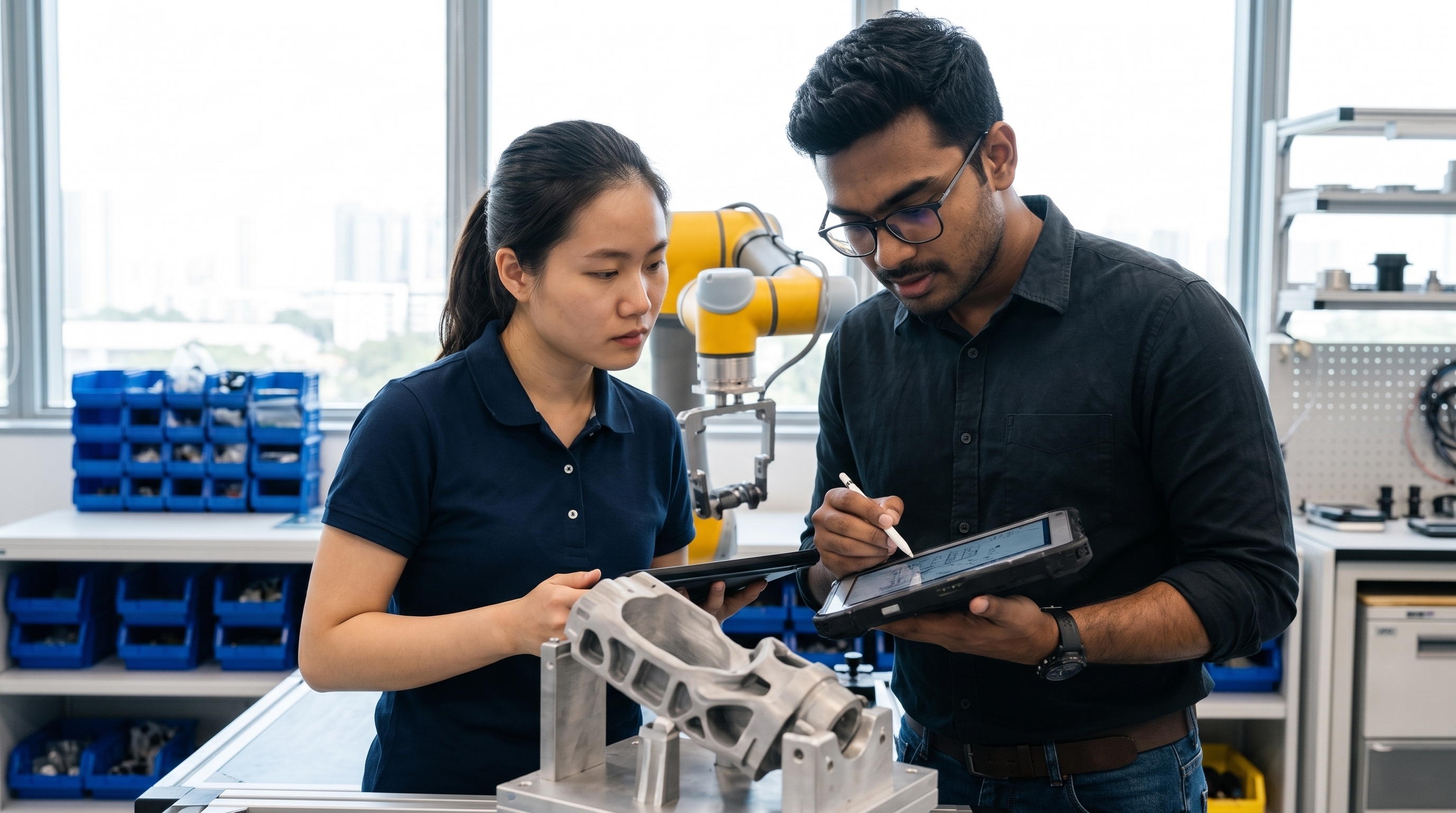
Smart manufacturing research: collaborative robotics, sensing, and additive manufacturing in the College of Engineering laboratories.
Curriculum
Core Research Competency Courses
Literature Reading and Seminar Discussion, Academic Writing, Applications of Artificial Intelligence, Research Methods, Experimental Design, and Computational Thinking. Four courses are offered on a rotating basis every two years.
Note that Applications of Artificial Intelligence and Computational Thinking are treated as core competencies for every doctoral student, not as specialist electives.
Specialized Elective Courses
Three courses are offered every three years from a catalog of approximately 70 courses spanning civil, environmental, mechanical, materials, and chemical engineering. Representative offerings:
- Special Topics in Digital Technology and Smart Construction
- Engineering Carbon Emission Management and Life Cycle Assessment
- Smart Manufacturing Systems and Smart Factories
- Circular Economy and Resource Reuse Engineering
- Resilient Cities and Sustainable Infrastructure
- Carbon Net-Zero Planning and Engineering Technology
- Hydrological Data Analysis and AI Applications
- Special Topics in Renewable Energy
- Advanced Reaction Engineering
- Special Topics in Optoelectronic Materials
What You Will Be Able to Do on Graduation
- Lead a research program independently, from identifying a frontier engineering problem through to executing original research.
- Apply AI and computational methods within your own discipline, with the judgment to know which methods suit which problems.
- Design experiments and analyses that hold up under scrutiny.
- Communicate your research in English at international level, writing for international journals and presenting at international conferences.
- Carry ethical and sustainability responsibility in engineering decisions.
Why Yilan Is a Good Place to Study Sustainable Engineering
Yilan City sits in northeastern Taiwan, about one hour from Taipei by train or coach.
Your research subjects are outside the campus gate. The Lanyang Plain is a major agricultural region, making agricultural residue valorization a live circular economy problem. The Lanyang River basin and the region's exposure to typhoons and heavy rainfall provide real data for hydrological modeling, flood simulation, and resilient infrastructure research. Yilan's long coastline supports coastal hazard adaptation fieldwork, and the region has geothermal resource potential relevant to renewable energy research.
Industry is nearby. Taiwan Cement Corporation, one of the program's industry partners, operates a production facility in Yilan.
Your money goes further. Living costs in Yilan are considerably lower than in Taipei, while the capital remains within easy reach for conferences, embassies, and international flights.
Program Overview
The Doctor's Program of Intelligent and Sustainable Engineering at National Ilan University launched in 2026. It is the first doctoral program in eastern Taiwan dedicated to the intersection of intelligent technology and sustainable engineering.
The program is built on three research pillars: Smart Manufacturing, Sustainable Green Technology, and Intelligent Sustainable Engineering Integration. Doctoral candidates develop expertise in artificial intelligence, circular economy principles, and advanced engineering to address climate change, resource scarcity, and industrial decarbonization.
A distinctive feature: you choose your major field from within a wide range of engineering disciplines, including chemical engineering, materials engineering, mechanical engineering, mechatronics engineering, environmental engineering, civil engineering, and architecture. The program is a framework for interdisciplinary doctoral research, not a single narrow specialization.
Industry partners include Siemens (Germany), Taiwan Cement Corporation, and CTCI Corporation.
Quick Facts
| Program name | Doctor's Program of Intelligent and Sustainable Engineering |
| Institution | National Ilan University (NIU), College of Engineering, Taiwan |
| Degree awarded | Ph.D. in Engineering |
| Established | 2026 |
| Places per year | 5 |
| Duration | 2 to 7 years |
| Credits to graduate | 22 coursework credits plus 12 dissertation credits |
| Language of instruction | English (100%) |
| English requirement | CEFR B1 or equivalent (TOEFL iBT 47+, IELTS 4+, TOEIC 550+, Duolingo 85+) |
| Application system | https://ccsys1.niu.edu.tw/InterExam/ (online only) |
| Application deadlines | Fall Round 1: January. Fall Round 2: April. Spring: October |
| Selection | Document review, followed by a video interview for shortlisted applicants |
| Tuition (College of Engineering, graduate) | NT$45,390 per semester |
| Type A scholarship | NT$8,000 monthly stipend plus full dormitory fee waiver |
| Type C scholarship | Full tuition and fee waiver |
| Dormitory | NT$9,500 per semester |
| Estimated living cost | NT$6,000 to NT$8,000 per month (NIU official estimate) |
| Location | Yilan City, Yilan County, northeastern Taiwan |
| Program contact | College of Engineering Office, engineering@niu.edu.tw, +886-3-9357400 |
| Admissions contact | Office of International Affairs, isa@niu.edu.tw |
Funding: The Numbers
Here is the complete picture using National Ilan University's own published figures.
Type A scholarship
NT$8,000 monthly stipend and free accommodation. NT$8,000 per month, which is NT$96,000 over a full year, together with a full waiver of the NT$9,500 per semester dormitory fee. Approximately US$2,900 to US$3,600 per year at the exchange rate range NIU publishes.
Type C scholarship
Full tuition and fee waiver. Tuition and miscellaneous fees for College of Engineering graduate programs are NT$45,390 per semester. Type C is awarded to every new doctoral student in the first year, and continues in the second and third years for students making normal academic progress with research underway.
Living costs and additional income
For reference, NIU estimates international student living costs at NT$6,000 to NT$8,000 per month.
Research assistantships and part-time positions are also available in the College of Engineering, and supervising professors may provide a research assistant stipend on top of the university scholarship.
Note: doctoral students may hold the NIU financial aid award for a maximum of 6 semesters. New students are awarded for one academic year; from the third semester onward, current students reapply each semester. The NIU award cannot be combined with a Taiwan Scholarship or other R.O.C. government scholarship.
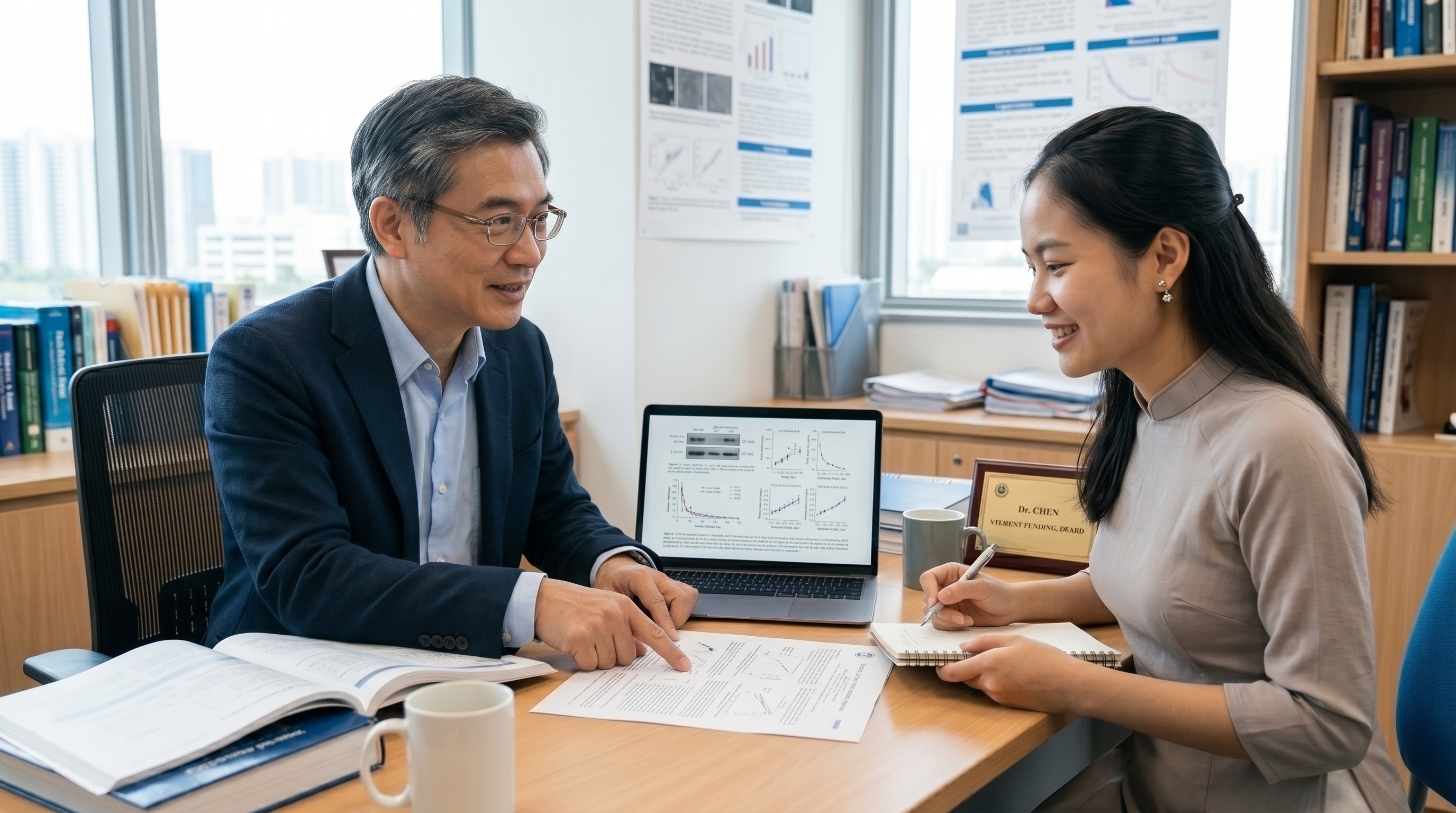
Five places a year against more than 60 professors: close, individual supervision from the first semester onward.
How to Apply
Applications are submitted online only. There is no paper application.
Step 1: Confirm eligibility and contact a potential supervisor
You are eligible if you hold foreign nationality, do not hold Overseas Chinese Student status, and meet the Ministry of Education's Regulations Regarding International Students Undertaking Studies in Taiwan.
Before you apply, decide which of the three research pillars fits your interests and contact the College of Engineering Office at engineering@niu.edu.tw to be connected with professors working in that area. Outline your research idea. Applicants who have established contact with a prospective supervisor are generally in a stronger position, and supervising professors may offer a research assistant stipend on top of the university scholarship.
Step 2: Prepare your documents
All documents are uploaded as PDF, one file per item. Merge multiple files into a single PDF where needed.
| Document | Notes |
| Online application form | Completed in the application system |
| Master's degree certificate | Must be authenticated by a Taiwan Overseas Embassy or Mission. In Chinese or English, or with a translation |
| Master's degree transcript | Must be authenticated, must show every semester's grades, and must include the grading scale |
| Copy of passport | As proof of nationality |
| English proficiency certificate | CEFR B1 or above. Accepted equivalents include TOEFL iBT 47+, TOEFL ITP 457+, IELTS 4+, TOEIC 550+, Duolingo English Test 85+, Cambridge Preliminary English Test (PET), Linguaskill Business 140+, GEPT Intermediate, FLPT 195+, and CSEPT 230+ (Level 1) or 240+ (Level 2). Certificates issued by your own institution are not accepted |
| Study plan | Approximately 300 words, in English, covering your background, why you are applying to NIU and this program, your study plan, and your plans after graduation |
| Financial certificate | Bank proof of at least US$3,000 in personal savings, dated within three months before the application period opens. A scholarship award letter may be used instead |
| Two recommendation letters | Submitted by your referees directly through the online system. Academic referees who can assess your research potential are preferred |
| Declaration form | Print from the system, read, sign, and upload |
Start the document authentication early. Having your degree certificate and transcript authenticated by a Taiwan Overseas Embassy or Mission takes time and is outside the university's control. If you cannot obtain authentication before the deadline, you may still apply, but admitted students must present the original authenticated documents at registration.
You may not need an English test. If you hold nationality of a country where English is an official or commonly used language, or you earned your previous degree in an English-speaking country, a copy of your passport may be submitted instead.
Accepted English proficiency tests
All scores below are equivalent to CEFR B1, the level required for admission.
| Test | Minimum score |
| CEFR | B1 Threshold |
| TOEFL iBT | 47+ |
| TOEFL ITP | 457+ |
| IELTS | 4+ |
| TOEIC | 550+ |
| Duolingo English Test | 85+ |
| Cambridge Main Suite | Preliminary English Test (PET) |
| Linguaskill Business | 140+ |
| GEPT | Intermediate |
| FLPT | 195+ |
| CSEPT | 230+ (Level 1) or 240+ (Level 2) |
Certificates issued by your own institution are not accepted. If you hold nationality of a country where English is an official or commonly used language, or you earned your previous degree in an English-speaking country, a copy of your passport may be submitted instead.
Step 3: Apply online before the deadline
Submit at https://ccsys1.niu.edu.tw/InterExam/ before 5:00 PM Taiwan time (GMT+8) on the closing date.
| Intake | Application deadline |
| Fall Round 1 (September entry) | January |
| Fall Round 2 (September entry) | April |
| Spring (February entry) | October |
Admission requirements are identical across all three rounds. If places fill in an earlier round, the remaining quota is announced at isa.niu.edu.tw.
What happens next
- Document review, roughly two to three weeks after the application closes.
- Video interview. Applicants for the Doctor's Program of Intelligent and Sustainable Engineering who pass the initial review are required to attend a video interview.
- Admission announced on the NIU website and in the application system.
- Admission letter mailed to the address you provided.
- Confirm your acceptance in the application system by the stated deadline. Failing to reply is treated as declining the offer.
- Airport pick-up is available, arranged one week before the semester begins.
Note that an admission letter does not guarantee a visa. Visas are issued by Taiwan's Bureau of Consular Affairs or an overseas Taiwan mission.
If you are admitted but cannot start, you may apply in writing to defer for one semester or one academic year at no cost, subject to approval.
Visa, Residency, and Working in Taiwan
Regulations current as of September 2026. Confirm with the Taiwan representative office in your country before you apply.
Coming to study
Apply for a Resident Visa at the Taipei Economic and Cultural Office or equivalent Taiwan mission in your country, using your NIU admission letter. After arriving, convert it to an Alien Resident Certificate (ARC) at the National Immigration Agency. Allow roughly six to ten weeks from admission to holding an ARC.
You cannot enter Taiwan on a tourist or visa-exempt entry and then switch to student status. Obtain the Resident Visa before you travel.
Insurance and health cover
At registration you must present proof of medical and injury insurance valid for at least six months from your date of entry, authenticated by a Taiwan overseas mission. After six months of residency you join Taiwan's National Health Insurance at NT$826 per month, which covers most clinic visits, hospital stays, and prescriptions at heavily subsidized rates.
Working during your studies
You must hold a work permit before taking any paid work, on or off campus, and working without one carries a substantial fine. The Office of International Affairs handles this and can advise you on the application.
Note also that Taiwanese banks do not offer student loans to international students. If you need a loan, arrange it in your home country before you arrive.
Staying in Taiwan after you graduate
Graduates may stay and work in Taiwan for up to two years after completing the degree. Full-time or part-time, without a sponsoring employer.
The Office of International Affairs at NIU advises students on visa and residency matters, and can confirm the current rules that apply to you.
Career Outcomes
A doctorate from the Doctor's Program of Intelligent and Sustainable Engineering at National Ilan University opens roles across engineering research, industry, consulting, and the public sector.
- Smart manufacturing and automation — R&D and systems integration in semiconductor, electronics, and precision machinery.
- Green energy and net-zero technology — Renewable energy, energy storage, and carbon reduction engineering.
- Environmental and water engineering — Water resources, waste treatment, and pollution control.
- Materials and process engineering — Advanced materials, chemical process design, and quality engineering.
- Civil, structural and infrastructure engineering — Resilient infrastructure, construction technology, and smart cities.
- AI and data engineering — Machine learning and data science applied to engineering systems.
- ESG and carbon management consulting — Life cycle assessment, carbon inventory, and sustainability reporting.
- University teaching and research — Academic posts in Taiwan or in your home country.
- Government and public research institutes — Policy, standards, and applied research roles.
- Licensed professional engineer — Civil, environmental, and structural professional practice.

An international research community drawn from across Asia, studying entirely in English in Yilan.
Living in Taiwan as an International Student
Do I need to speak Chinese? Not for your studies. The Doctor's Program of Intelligent and Sustainable Engineering is taught entirely in English, and there is no Chinese language requirement for admission to this program. For daily life in Yilan, basic Mandarin is useful, and NIU's Languages Education Center offers Chinese courses.
Is Taiwan safe? Taiwan consistently ranks among the safest places in Asia for international students.
Will I be alone? National Ilan University hosts an international student community drawn from across Asia, including Vietnam, Indonesia, India, Malaysia, Thailand, and the Philippines.
Arriving. NIU provides an airport pick-up service, arranged one week before the semester begins. Bring enough cash in NTD or USD for your first fees and expenses, and open a local account at a bank or post office near campus after you settle in.
Frequently Asked Questions
Q1: What are the research areas of the Intelligent and Sustainable Engineering PhD Program at National Ilan University?
The program has three research pillars: (1) Smart Manufacturing, covering advanced automation, smart factories, and industrial sensing technology; (2) Sustainable Green Technology, including carbon net-zero planning, life cycle assessment, and circular economy; (3) Intelligent Sustainable Engineering Integration, applying AI to resilient city planning, environmental disaster simulation, and hydrological data analysis. Doctoral candidates choose a major field from chemical, materials, mechanical, mechatronics, environmental, and civil engineering, architecture, and related areas.
Q2: How competitive is admission with only 5 places?
A small cohort does not mean a high barrier. The program admits 5 students per year but draws on more than 60 full-time professors in the College of Engineering, giving an exceptionally favorable supervision ratio. Selection focuses on the fit between your research proposal and a prospective supervisor's work, rather than on grades alone. Contacting a potential supervisor before applying is strongly recommended.
Q3: What are the research strengths of National Ilan University's College of Engineering?
The College of Engineering at National Ilan University has 12 professors named on the Stanford University / Elsevier "World's Top 2% Scientists" list, more than 60 full-time professors, and an average of over 16 publications per faculty member. The university is a member of the Taiwan AI College Alliance, opened an AI Promotion Office in 2024, and became an NVIDIA partner university in 2025. NIU is ranked 401 to 600 globally for SDG 9 (Industry, Innovation and Infrastructure) in the Times Higher Education 2026 Sustainability Impact Ratings.
Q4: Do I need to speak Chinese to study in this program?
No. The Doctor's Program of Intelligent and Sustainable Engineering at National Ilan University is taught entirely in English, including coursework, seminars, supervision, and the dissertation. There is no Chinese language requirement for admission. The requirement is English at CEFR B1 or above, demonstrated by TOEFL iBT 47+, IELTS 4+, TOEIC 550+, Duolingo 85+, or another accepted equivalent. Applicants from countries where English is an official language, or who earned their previous degree in an English-speaking country, may submit a passport copy instead.
Q5: My previous degree is not in engineering. Can I still apply?
Yes. The Doctor's Program of Intelligent and Sustainable Engineering at National Ilan University accepts applicants from non-engineering backgrounds where their research interests align with the three pillars. Doctoral candidates choose a major field from chemical engineering, materials engineering, mechanical engineering, mechatronics engineering, environmental engineering, civil engineering, architecture, and related areas, so the program accommodates a wide range of entry backgrounds.
Q6: How long does the Ph.D. take, and how many credits are required?
The program runs from 2 to 7 years. Graduation requires 22 coursework credits (4 required credits from Seminar on Intelligent and Sustainable Engineering I through IV, plus 18 elective credits) and 12 dissertation credits. The coursework requirement is deliberately lighter than the 30 or more credits typical of doctoral programs in Taiwan, leaving more time for research.
Q7: Where is Yilan and how far is it from Taipei?
Yilan City is in northeastern Taiwan, roughly one hour from Taipei by train or coach, with frequent services. Living costs in Yilan are considerably lower than in Taipei, which makes the funding package go further, and Taoyuan International Airport is accessible for international travel.
Q8: Which companies partner with the program?
The Doctor's Program of Intelligent and Sustainable Engineering at National Ilan University partners with Siemens (Germany), Taiwan Cement Corporation, and CTCI Corporation, offering joint supervision, internships, and directed research scholarships. Taiwan Cement operates a production facility in Yilan, placing an industrial research site close to campus.
Q9: Is the Intelligent and Sustainable Engineering PhD Program at National Ilan University fully funded?
Two awards apply. The Type C scholarship is a full tuition and fee waiver, awarded to every new doctoral student in the first year and continuing in the second and third years for students making normal academic progress with research underway. The Type A scholarship adds a monthly stipend of NT$8,000, which is NT$96,000 over a full year, together with a full waiver of the NT$9,500 per semester dormitory fee. Research assistantships and supervisor-provided stipends are also available.
Q10: Will the stipend cover my living costs in Taiwan?
For reference, National Ilan University estimates international student living expenses at NT$6,000 to NT$8,000 per month, covering meals, books, and travel. The Type A scholarship stipend is NT$8,000 per month.
Q11: How long does the scholarship last?
Doctoral students at National Ilan University may hold the financial aid award for a maximum of 6 semesters. New students receive the award for one academic year; from the third semester onward, students reapply each semester based on the previous semester's academic performance. The NIU award cannot be held at the same time as a Taiwan Scholarship or other R.O.C. government scholarship.
Q12: What documents do I need to apply?
The Doctor's Program of Intelligent and Sustainable Engineering at National Ilan University requires: the online application form; your master's degree certificate and transcript, both authenticated by a Taiwan Overseas Embassy or Mission; a copy of your passport; an English proficiency certificate at CEFR B1 or above; a study plan of approximately 300 words in English; financial proof of at least US$3,000 in personal savings dated within three months of the application opening; two recommendation letters submitted online by your referees; and a signed declaration form. All are uploaded as PDF.
Q13: When are the application deadlines?
The Doctor's Program of Intelligent and Sustainable Engineering at National Ilan University admits in three rounds each year. For fall admission (September entry), Round 1 closes in January and Round 2 closes in April. For spring admission (February entry), the deadline is October. All rounds close at 5:00 PM Taiwan time, and requirements are identical across rounds. Confirm exact dates and apply at https://ccsys1.niu.edu.tw/InterExam/.
Q14: Is there an interview?
Yes. Applicants to the Doctor's Program of Intelligent and Sustainable Engineering who pass the initial document review are required to attend a video interview. Selection is based primarily on the written application, with the interview confirming fit between your research interests and the program.
Q15: What visa do I need, and how do I get it?
You need a Resident Visa, applied for at the Taipei Economic and Cultural Office or equivalent Taiwan representative office in your country, using the admission letter from National Ilan University. After arriving in Taiwan, you convert it to an Alien Resident Certificate within 30 days. You cannot enter Taiwan on a tourist or visa-exempt basis and switch to student status afterward. Allow six to ten weeks from admission to holding an ARC.
Q16: Can I work in Taiwan after I graduate?
Yes. Graduates may stay and work in Taiwan for up to two years after completing the degree. Full-time or part-time, without a sponsoring employer. The Office of International Affairs at National Ilan University advises students through this process.
Q17: Can I work part-time while studying?
Yes, once you hold a work permit. The Office of International Affairs at National Ilan University handles these applications and can advise you. The Doctor's Program of Intelligent and Sustainable Engineering also offers research assistantships and part-time positions within the College of Engineering.
Q18: What if I am admitted but cannot start that semester?
Admitted doctoral students may submit a written application to the NIU Office of Academic Affairs to defer admission by one semester or one academic year, before the official start of the semester. No fee is charged. Deferral is valid only once approved by the university.
Contact
- Program enquiries: College of Engineering Office, National Ilan University. engineering@niu.edu.tw, +886-3-9357400
- Admissions and application enquiries: Office of International Affairs. isa@niu.edu.tw, https://isa.niu.edu.tw
- Visa, ARC, and work permit enquiries: International Student Affairs Division, Office of International Affairs. isa@niu.edu.tw
- Address: No. 1, Section 1, Shennong Road, Yilan City, Yilan County 260, Taiwan
- Apply at: https://ccsys1.niu.edu.tw/InterExam/